

PARAMENTS

Sundays after Pentecost
The times in the Church year between special seasons is sometimes called “Ordinary Time” because these Sundays have no seasonal names. Instead, these “extra” Sundays are designated solely by “ordinal” numbers–hence the term “ordinary.” The 20+ Sundays after Pentecost that fall in the summer months center on Christian growth and missions. Many of the readings for these Sundays are of Jesus’ teachings and parables, and of Paul’s letters to the fledgling churches.
Green is used for this time of year since it has traditionally been considered the color of life, the symbol of vegetation and growing things. Therefore, it represents our growth in faith as we follow Jesus. On the altar and pulpit paraments there is a centering cross reminding us that our life should always be centered in Christ. The style of the cross represents growth with the use of a light green (the color of new growth and regeneration) and with the extending, “growing” lines of the inner cross. Our Christian growth starts with the saving grace of Christ at the center and moves outward. This growth should first be in our personal faith through and in Christ and then in our reaching out to each other, our community, and the world in love and to “Go and tell others.” Over the cross is a representation of a grapevine and a sheath of wheat which can represent maturing in our Christian growth. They also remind us of the many parables of Jesus that we hear read during this time of year in which he teaches that he is the vine and we are the branches that are to “bear much fruit.” He also taught that he is the “bread of life”. The grapes and wheat remind us of the bread and wine which, through the mystery of the Eucharist, become the true Body and Blood of Jesus Christ. They also remind us of the abundance of God’s blessings.

The Red Paraments
Red is traditionally the color of power, strength and fire. This color is appropriately used on Pentecost Sunday when we remember the Holy Spirit coming in the power of wind and tongues of fire. Red is also a festive color, consequently, it serves in the Lutheran church year as the color for Reformation Sunday and other congregational festive occasions such as dedications, ordinations and installations.
The symbolism of our Red paraments is one of simplicity with a large, square-shaped cross at the center. The square cross is often used as a symbol of strength and stability. It has been divided into 4 parts reminding us of the four evangelists/gospels – Matthew, Mark, Luke, John – and Christ’s great commission that we are to go out to the four corners of the world with his gospel and “make disciples of all nations” (Matt. 28:19). The cross is surrounded by a single red circle of representing unity and stylized symbols that can be viewed as crowns, rays or flames. Three outer intersecting golden circles – a reoccurring theme through most of the parament sets – are a symbol of eternity and the Trinity.
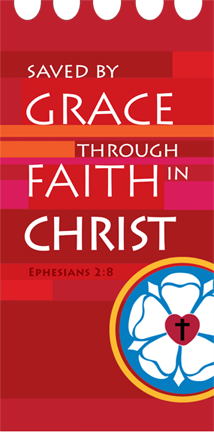
The Reformation Banner
The Reformation Banner is made up of various shades of red, a color associated with festive occasions in the Lutheran liturgical year. Reformation Sunday is a day of remembrance of the call to reform of the Church by Dr. Martin Luther in the 15th century. One of his reform themes from Ephesians 2:8 “For it is by grace you have been saved, through faith–and this is not from yourselves, it is the gift of God.” is summarized on the banner. The bottom area displays The Luther Rose or Seal which was designed by Luther as a personal expression of his theology and faith.